 Tenerife Excursions
Home › Guides › Best time to visit Tenerife: weather, Teide and whales by month
Best time to visit Tenerife: weather, Teide and whales by month
The best time to visit Tenerife is April to October, with 0 to 4 mm of rain a month in the south. This page shows what each season means for weather, Teide, whales and walks, and which trips from Tenerife excursions suit which time of year.
Quick answer The short answer on when to go
The best time to visit Tenerife is April to October, when it barely rains in the south. For walking, go in spring or autumn. Whales are around all year, and Teide in winter works only with some weather luck. Santa Cruz averages 18.2 °C in January and 25.5 °C in August.
Key takeaways
- Beach and sun: April to October, almost no rain in the south, and you can book suitable Tenerife excursions all year.
- Teide in winter: the cable car runs almost every day but can stop in wind, see the Teide cable car.
- Whales and dolphins: possible all year, with every boat on the whale watching Tenerife page.
- Walking in Masca and Anaga: spring and autumn, with more on the Anaga Rural Park.
When is the best time to visit Tenerife, at a glance?
April to October is the most settled, but you can visit Tenerife all year.
Tenerife has no real winter slump. The differences between the seasons show mainly in rain, hours of sunshine and on Teide. The table gives official averages from the state weather agency AEMET for Santa Cruz in the north-east and for the airport in the south.
The seasons compared
The figures are averages from 1981 to 2010. They show what you can typically expect, not what happens on a particular day.
| Period | Weather in numbers | Good for |
|---|---|---|
| December to February | Santa Cruz averages 18.2 °C in January, the south airport reaches a daily high of 21.7 °C in January, and Santa Cruz gets 43 mm of rain and 168 hours of sunshine in December | Sun instead of snow at home, Teide with snow, boats and whales, town and coast |
| March to May | Mild weather, and in the south from May 0 to 4 mm of rain a month | Walking in Anaga and Masca, Teide tours, first beach days |
| June to September | Santa Cruz averages 25.5 °C in August, the south airport reaches a daily high of 28.4 °C in August, and in July there is 0 mm of rain and 337 hours of sunshine | Beach, boat trips, Teide sunset, quad and buggy early in the day |
| October to November | Still warm, and in the north the rain slowly returns | Walking, island tour, quieter places |
When is it warmest and when is it coolest?
According to AEMET, August is the warmest month. Santa Cruz averages 25.5 °C, and at the south airport the daily high is 28.4 °C. In January Santa Cruz averages 18.2 °C and the south reaches a daily high of 21.7 °C. The annual average is 21.5 °C in Santa Cruz and 21.4 °C at the south airport.
The gap between summer and winter is therefore smaller than in central Europe. For excursions this means: in winter you need a jacket for Teide and one for the evening, but no winter clothing for the coast.
Sources: Turismo de Tenerife, AEMET, AEMET.
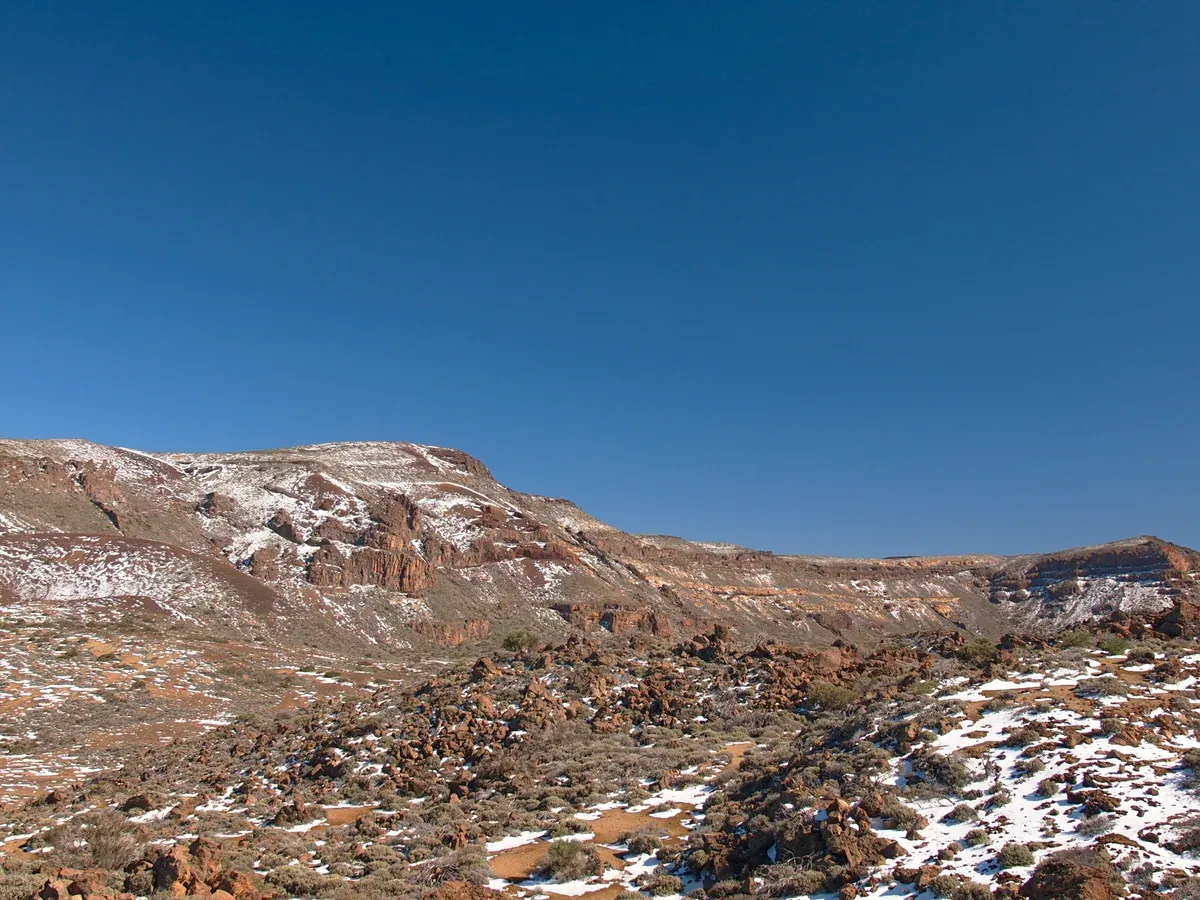
In winter there can be snow at the top while the coast below often still has beach weather. Photo: 3berp, CC BY-SA 4.0, via Wikimedia Commons
When is the best time to go walking in Tenerife?
The best time to walk is spring from March to May and autumn from September to November.
In these months it is neither too hot nor too cold for long distances. In high summer it can get tiring in the south and in the Masca gorge, and in winter the north is wetter more often.
Spring: green and not too hot
In spring Anaga in the north-east and the area around Teide are at their greenest. If you want a guided walk, the Anaga Rural Park page has the Anaga mountains: circular walk in the laurel forest and the Anaga walk with local products.
On the south coast from May, with 0 to 4 mm of rain a month, you can be almost sure of sun. In the north winter lingers a little longer.
Autumn: clear views and empty trails
In September and October it is still warm during the day, and the trails are emptier. From November the rain in the north increases again. For walks in Teide National Park, altitude matters more than the season: at around 2,000 m the annual temperature is about 10 to 11 °C, and in summer 20 to 25 °C during the day.
Always pack one layer more than you would wear on the coast.
Masca: when the gorge works
The walk through the Barranco de Masca is one of the best known on the island. Access is only possible with a reservation, and the only permitted way to reach Masca is the TITSA line 355 from Santiago del Teide, about 20 minutes, according to the operator's site. As guided options there are the Masca Gorge: guided walk with boat trip and the Masca Gorge with audio guide.
In high summer start early, and in winter check beforehand whether rain has made the paths wet.
Sources: Turismo de Tenerife, Camino Barranco de Masca.
How do the north and south differ in weather?
The south is drier and warmer, the north greener, cloudier and wetter.
Teide divides the island into two climate zones. As a weather divide it holds back the moist air from the north-east. That explains why it can rain in Puerto de la Cruz while the sun shines in Los Cristianos.
Santa Cruz and the south airport compared
Santa Cruz in the north-east averages 226 mm of rain a year, 0 mm in July and 43 mm in December. In the south near Tenerife Sur it is only 132 mm a year. From May to September almost no rain falls there, namely 0 to 4 mm a month.
For hours of sunshine, Santa Cruz averages 2,913 a year, 337 in July and 168 in December. That means there is sun in winter too, but the sky in the north is cloudy more often.
What this means for choosing your excursions
If you stay in the north, plan a trip to the south for beach days, and the other way round for walking in the north. It gets cooler with height: a rule of thumb says the temperature drops by 1 °C for every 100 m of altitude. On the way up to Teide you therefore pass through several weather zones in one day.
There is more on the Teide National Park page. Depending on whether your pickup is in the south or the north, the excursions on Tenerife excursions also differ, and the pickup is stated in every listing.
What is the weather like on Teide in winter?
In winter the temperature at higher altitudes is often close to 0 °C, with occasional snow or ice.
The national park lies at around 2,000 m and in winter is a different destination from the coast. Wind, snow, ice or fog can affect trails and access roads.
Cable car: almost always open, but weather dependent
According to the operator, the cable car closes as planned only on 25 December. In bad weather, however, it can stop running, depending on wind speed and temperature. In winter, therefore, allow a buffer and book a trip where you can use the ride flexibly.
Which tours include the cable car ticket in the price is listed on the Teide cable car page. The Teide tour with cable car ticket and pickup includes it, and with many other tours you have to add it.
Stars and the observatory in winter
If you want stars in winter, bear in mind that visits to the Observatorio del Teide are suspended from December to March because of bad weather, as the IAC institute states. For an observatory tour, check beforehand whether it runs in winter. Evening tours such as Teide at night: sunset and stars depend on the sky.
A clear night is never guaranteed, with more on the Teide stargazing tour page.
Snow and quad bikes
Snow on Teide is possible from December to February. It makes the park attractive but can close roads and paths. For the quad and buggy tours in the park, they are cancelled in ice or strong wind.
You can find the offers on the quad biking Tenerife page.
Sources: Turismo de Tenerife, Teleférico del Teide, Instituto de Astrofísica de Canarias.
Can you see whales and dolphins in Tenerife all year?
Yes, bottlenose dolphins and short-finned pilot whales live off Tenerife all year.
The boats run all year, and the season hardly matters for the whales. According to the tourism board, up to 21 species live in the waters.
How likely is a sighting?
Whale watching is possible on about 8 days out of 10. The tourism board puts the chance of a sighting at almost 100 percent. No operator can promise it, because whales are wild animals. The waves matter more: in high seas boats leave later or not at all, and small boats rock more.
The whale watching Tenerife page lists every boat with price, duration and departure port. The choice includes the whale and dolphin cruise with underwater view and the whale watching on a sailing boat with drinks.
Which months are pleasant on a boat?
In summer the sea is usually calmer and it is hot on deck, while in winter it is cooler and the wind is stronger. Pack a jacket and sun protection in every season. If you fear seasickness, choose a bigger boat or the shorter trip.
Source: Turismo de Tenerife.
Which excursions suit which season?
Teide and boats work almost always, walks need mild weather, and beach days need summer.
The table matches the excursions on this page to the seasons. You can find all tours on the homepage under Tenerife excursions.
Excursion and best time
The matching follows the weather at each destination and is a guide only.
| Excursion | Best time | Note |
|---|---|---|
| Teide tour with cable car ticket and pickup | All year | Dress warmer in winter, and in wind the cable car can stand still |
| Teide at night: sunset and stars | Spring to autumn | In winter it is close to 0 °C at the top and cloudier more often |
| Whale watching without hunting from Los Cristianos | All year | Whales live off the coast all year, and the swell decides |
| Island tour: Teide, Masca, Icod and Garachico | Spring and autumn | Long day tour, and hot in Masca in high summer |
| Masca Gorge: guided walk with boat trip | Spring and autumn | Reservation needed, start early |
| Anaga mountains: circular walk in the laurel forest | March to May, September to November | In winter often cloud and rain in the north-east |
| La Gomera day trip with ferry and lunch | All year | Depends on the sea state for the ferry, see La Gomera day trip from Tenerife |
Is there a quieter time?
Travelling cheaply is possible from November to February, except on public holidays. At this time the trails are often emptier. In return, expect more cloud in the north.
If you want to combine a day on Teide with an evening by the sea, plan a spare day for it in winter.
Sources: Turismo de Tenerife, Teleférico del Teide.
When does it rain most in Tenerife?
In winter, especially in the north, while the south stays dry all year.
With 43 mm of rain, December is the wettest month in the AEMET figures this page quotes for Santa Cruz. In July there is 0 mm.
How many rainy days are there in winter?
In winter it rains on the north side on five to seven days a month. That is not constant rain, as clouds often pass through and the sun comes out again. A rainy day therefore rarely spoils a whole trip. If you book flexibly, you can put walks and viewpoint tours on a sunny day. In the south only 132 mm falls in the whole year, and in the summer months almost nothing.
The sun shines in winter too, as Santa Cruz has 168 hours of sunshine in December.
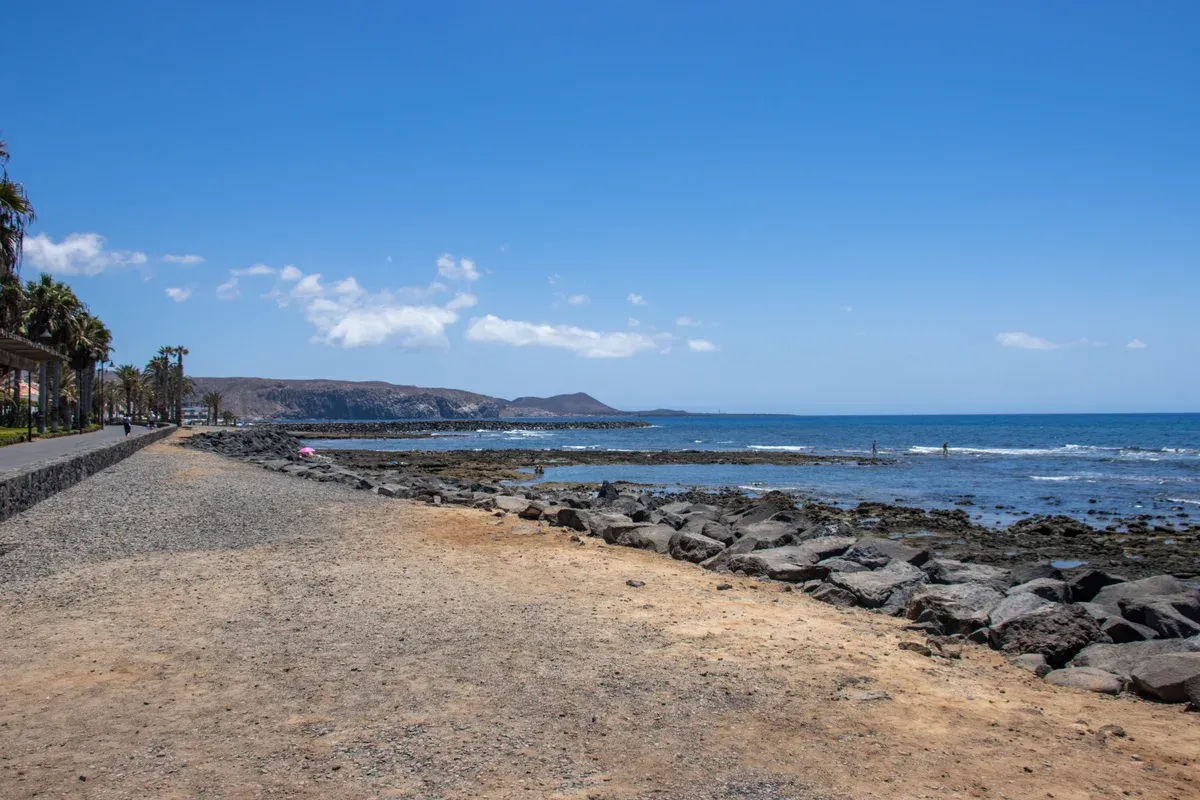
In the south the sun shines almost all year, which makes it the safe choice for beach days. Photo: Photograph by Mike Peel ( www.mikepeel.net )., CC BY-SA 4.0, via Wikimedia Commons
Frequently asked questions about when to go
When is the best time to go walking in Tenerife?
From March to May and from September to November. You can find guided tours for this in the Anaga Rural Park.
When is the best time to visit Tenerife in general?
April to October, with very little rain in the south. You can see all excursions under Tenerife excursions.
Is there snow on Teide in winter?
Yes, snow is possible from December to February. The cable car can stop in wind, see the Teide cable car.
When are there whales off Tenerife?
All year, on about 8 days out of 10 according to the tourism board. Boats are listed on the whale watching Tenerife page.
Which month is the warmest in Tenerife?
August, with an average of 25.5 °C in Santa Cruz according to AEMET. For details on the height of Teide see the Teide National Park.
When is Tenerife cheapest?
From November to February, except on public holidays. Day trips such as the Tenerife island tour are then often quieter too.
More Guides
- Teide National Park: Getting There, Hiking Trails and Excursions
Teide National Park: how to get there, what to see, rules and tours. Excursions compared, with English guides. Pick yours 2027.
- Anaga Rural Park: laurel forest hikes and guided tours
Anaga Rural Park in 2027: 2 guided hikes with an English guide, 2.5 to 3.5 hours, permit and directions. Compare the tours now.
- Teide Cable Car: Tickets, Prices and Tours with Cable Car Ticket
Teide cable car to 3,555 m: prices, times and tours with the ticket included. Compare and pick the right excursion 2027.